
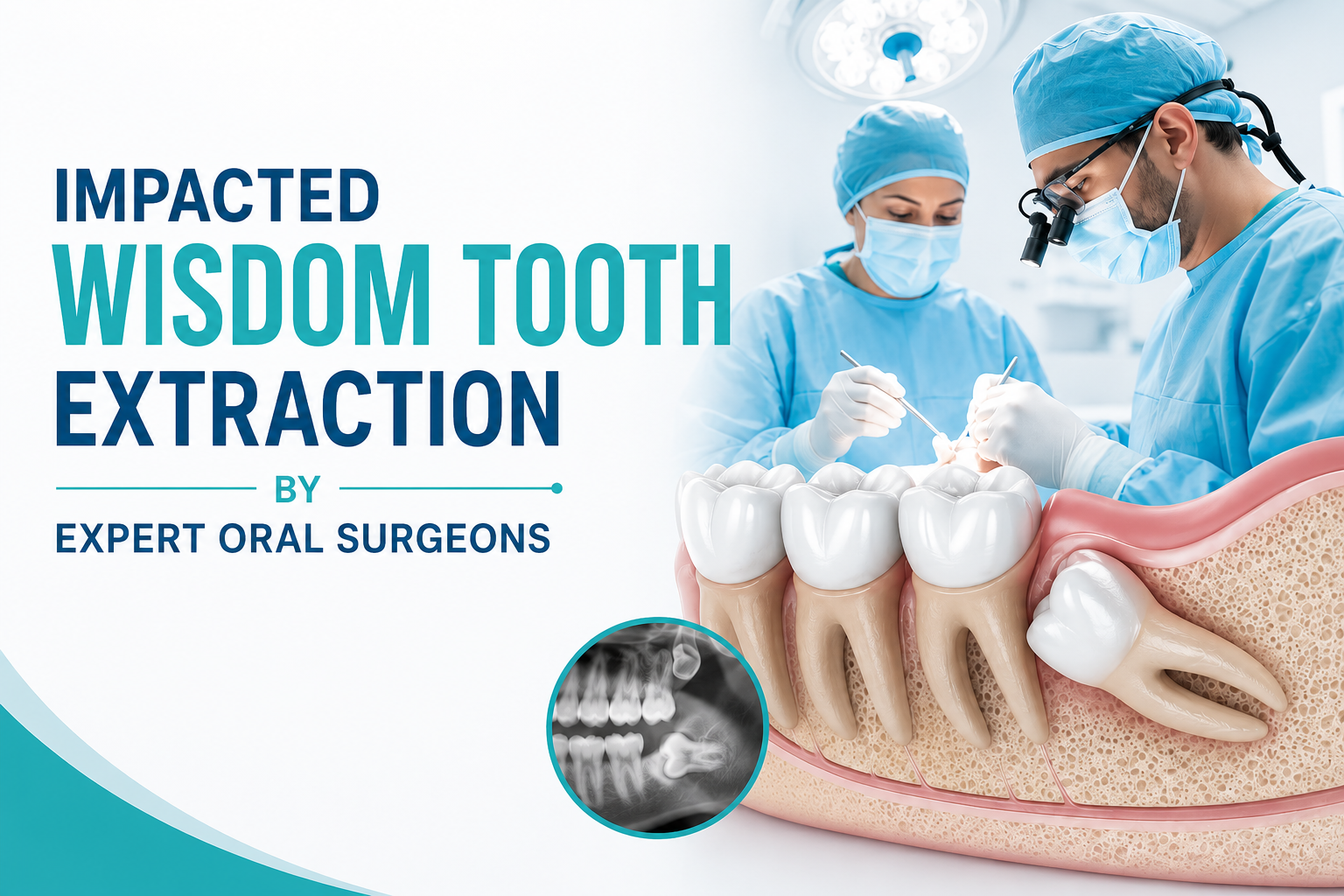
A wisdom tooth that is impacted, means that the third molars in the back of your mouth do not have the space they need to develop or come out. These teeth normally seek to erupt during your late teens or early twenties, but once they get stuck under the gum line or erupt at awkward angles, they may lead to serious oral health issues that must be addressed by a professional.
Surgical removal of wisdom teeth is considered to be one of the most widespread oral surgeries nowadays, and millions of individuals are receiving such treatment every year. Wisdom teeth removal can be a much less overwhelming experience when one understands the process, when to get help, and when to recover.
Why Wisdom Teeth Become Impacted
There are a number of reasons why wisdom teeth get impacted. This is mainly due to evolutionary factors- modern human jaws are generally smaller than those of our ancestors, and the space they have to fit in these additional teeth is not enough. Since the nature of our diet has evolved across the millennia, and thus we no longer need large molars to grind our food, our jaws have evolved to fit.
The other causative factors are:
- Genetics: Jaw size and positioning of teeth are hereditary.
- Overcrowding: In cases where existing teeth do not leave any room for the emergence of the wisdom teeth.
- Angle of eruption: sideways, backwards, or wrong-angled teeth.
- Late development: Late eruption of wisdom teeth after the jaw has fully developed.
Types of Impacted Wisdom Teeth
Dentists categorize impacted teeth into various groups depending on their location and their angle of orientation. Understanding these kinds of impacted wisdom teeth can be used to decide on the best treatment method:
The most widespread is Mesial impaction, in which the tooth is tilted forward towards the front of the mouth. Distal impaction takes place when the tooth bends flat towards the back of the mouth, whereas vertical impaction takes place when the tooth develops straight but gets stuck under the gum line. The most problematic may be horizontal impaction, where the tooth lies totally on its side.
Moreover, impactions are also categorized by depth: soft tissue impaction (only enclosed by gum tissue), partial bony impaction (somewhat enclosed by jawbone), and complete bony impaction (enclosed by bone entirely).
Impacted Wisdom Tooth Symptoms
Recognizing the signs early can prevent serious impacted wisdom tooth complications. Common impacted wisdom tooth symptoms include:
- Persistent wisdom tooth pain at the back of your mouth
- Red, swollen, or tender gums
- Jaw pain and stiffness
- Difficulty opening your mouth fully
- Unpleasant taste or bad breath
- Swelling around the jaw
- Headaches radiating from the jaw area
Some patients experience no symptoms initially, which is why regular dental check-ups with X-rays are crucial for detecting impacted wisdom teeth before problems develop.
Potential Complications
The untreated wisdom teeth may cause serious complications. These can be infections, cyst development around the affected tooth, damage to the neighbouring teeth, and predisposition to gum disease. The pressure caused by the affected wisdom teeth can even reposition your other teeth, which may erase the years of orthodontic treatment.
Infection may arise, and it may be a dental emergency that needs urgent treatment. Symptoms are extreme pain, swelling of the face, trouble with swallowing, fever, and swollen lymph nodes. If you have these symptoms, call an oral surgeon.
How to Extract an Impacted Wisdom Tooth
The method of extraction depends on the intensity of the impaction. The process of how to extract an impacted wisdom tooth is done by qualified oral surgeons who use a step-by-step process:
You will be given local anaesthesia, sedation, or general anaesthesia before the surgical removal of the molar takes place, and this will depend on the complexity and the level of comfort you have. The surgeon cuts incision in the gum tissue to reveal the tooth and bone. If bone blocks the use of dentin pull, this is removed with care. The tooth can also be sectioned to be easy to remove, particularly in cases of high impaction.
How long does an impacted wisdom tooth extraction take?
Simple extractions can require 20-30 minutes, whereas complex surgical extractions can take 45 minutes and up to an hour on an individual tooth. The more than one extraction within a session prolongs the process.
Recovery and Aftercare
Knowing what to do following affected wisdom tooth removal is important to a smooth recovery. Just after the surgery, bite the gauze pad on the extraction site as a way of controlling bleeding. Use ice packs to reduce swelling in the first 24-48 hours.
Prescription drugs or over-the-counter pain relievers are the recommended methods of impacted wisdom tooth pain relief. Always administer drugs as prescribed and do not take more than the required amount.
The duration of healing after extractions of teeth varies according to personal factors and complexity of the extraction. The gum tissue takes 1-2 weeks to heal initially, and 3-6 months to heal fully of the bone. The majority of patients resume normal life in a few days, although full recovery takes time.
During recovery:
- Eat soft foods and gradually reintroduce solid foods
- Avoid drinking through straws the suction can dislodge blood clots
- Don’t smoke or use tobacco products
- Gently rinse with warm salt water after 24 hours
- Maintain oral hygiene while being gentle around extraction sites
- Rest adequately and avoid strenuous activities
Understanding Dry Socket
Dry socket is one of the complications to watch out for because it is a painful condition that arises due to the loss of the blood clots at the extraction site. This leaves bone and nerves exposed, which brings about intense pain that normally begins 2-3 days after extraction. The symptoms are great pain, bad smell, and bad taste. In case of any suspicion of dry socket, call your oral surgeon without delay, and you may be required to apply some form of medicated dressing.
When Wisdom Teeth Removal Becomes Urgent
Although there are cases of wisdom teeth removal surgeries that are conducted beforehand, there are cases that are urgent. A wisdom teeth emergency dental problem may involve an extreme infection, uncontrolled bleeding, severe pain that is not responding to medication, or extreme swelling in the face that makes it difficult to breathe or swallow.
Although mild dental problems can be solved using conservative options such as a tooth filling, the affected wisdom teeth may need surgical skills. The inability to accept the issue or postpone the treatment may turn a relatively straightforward process into a complicated emergency that involves more intrusive actions.
Conclusion
Managing impacted wisdom teeth doesn’t have to feel overwhelming when you have trained experts by your side. Our qualified oral surgeons at the Carrum Downs Dental Group have specialized in wisdom teeth removal, which is done using the latest technology and state-of-the-art methods that provide a comfortable and efficient process with the best results.
Our staff provides total care from the initial consultation to full recovery, and we offer individual treatment plans that are tailored to your needs. We know how anxious oral surgery can be, and we guarantee that patient comfort, effective communication, and kind care are top priorities during your process.
Carrum Downs Dental Group will take care of you whether you are suffering pain in your wisdom teeth, you have been recommended to undergo a preventive extraction, or you require a dental emergency. Call us now to make your appointment and start the journey to the best oral health with the best professionals in town.
Related Post –
How to Spot and Treat Wisdom Tooth Decay Early